

Best Solar Generator for Home Backup 2026
Table of Contents
-
Top Solar Generators for Home Backup in 2026
- EcoFlow DELTA Pro 3: Best for Whole-Home Coverage
- Jackery Solar Generator 2000 Plus: Best Balance of Portability and Power
- BLUETTI AC300: Best Modular System for 240V Appliances
- Goal Zero Yeti 6000X: Best for Reliable Long-Term Use
- Nature's Generator Powerhouse 6500W: Best for High-Output Whole-Home Backup
- Lion Energy Safari ME: Best for RV and Home Dual Use
- Renogy Phoenix 1000: Best Entry-Level Option
- Solar Generator Capacity Requirements: How Many Watt-Hours Do You Need?
- Solar Generator vs Gas Generator for Home: Which Makes More Sense?
- Battery Chemistry, Inverter Output, and What the Specs Actually Mean
- Solar Panel Compatibility, MPPT Controllers, and Charging Methods
- Solar Generator Tax Credits 2026: What Homeowners Can Claim
- Long-Term Maintenance, Degradation, and Integration with Home Panels
- Conclusion
Last Updated: August 14, 2026
Top Solar Generators for Home Backup in 2026
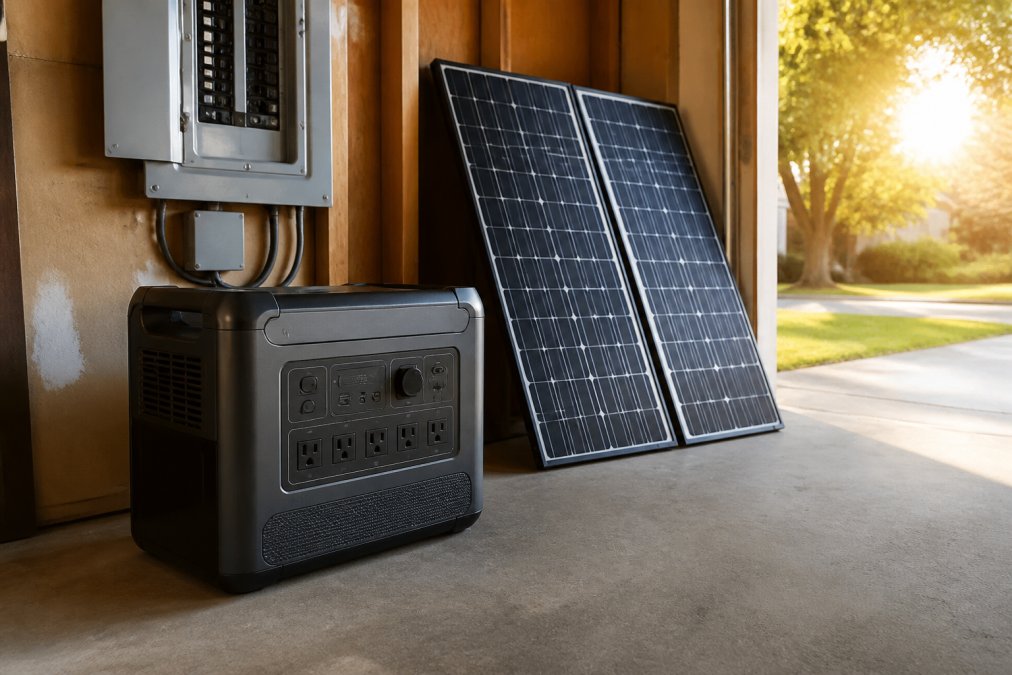
Power outages are becoming longer and more frequent, making fuel-free solar generators an attractive alternative to gas backup and expensive transfer switch installations. At Outdoor Power & Grill, we carry premium brands including Jackery and Mango Power. This guide cuts through spec-sheet noise to help you find the right fit.
Quick Picks:
- Best for Whole-Home Coverage: EcoFlow DELTA Pro 3 - massive expandable capacity, smart home panel integration
- Best Balance of Portability and Power: Jackery Solar Generator 2000 Plus - 2,042Wh base, expandable to 12kWh
- Best Modular System: BLUETTI AC300 - flexible battery modules, 240V capable
- Best Long-Term Reliability: Goal Zero Yeti 6000X - 6,071Wh, strong build quality
- Best High-Output Option: Nature's Generator Powerhouse 6500W - unique wind turbine compatibility
- Best RV/Home Dual Use: Lion Energy Safari ME - 30-amp RV port, 3,000W inverter
- Best Entry-Level: Renogy Phoenix 1000 - ultra-fast charging, LFP battery
EcoFlow DELTA Pro 3: Best for Whole-Home Coverage
The EcoFlow DELTA Pro 3 is the closest thing to a whole-home solar backup system in portable form. Starting at $4,599, it offers expandable capacity up to 90kWh and output ranging from 7.2kW to 21.6kW, rivaling permanently installed battery systems. The standout feature is Smart Home Panel integration, the unit connects directly to your home's electrical circuits and switches over automatically during an outage, eliminating manual extension cord setup.
Pros: Expandable to 90kWh; fast charging; true home panel integration Cons: High initial investment; overkill for essential-appliance-only backup
Jackery Solar Generator 2000 Plus: Best Balance of Portability and Power
The Jackery 2000 Plus offers serious backup without semi-permanent installation. Base capacity is 2,042Wh, expandable to 12kWh, with 3,000W AC output and 6,000W surge capacity handling refrigerators, sump pumps, and motor-start appliances. The LiFePO4 battery is rated for 4,000 charge cycles, at one cycle daily, that's over a decade before degrading to 80% capacity. At $3,099, it offers strong mid-range value.
Pros: Excellent portability; long cycle life; strong surge capacity Cons: Full expandable system represents significant investment
BLUETTI AC300: Best Modular System for 240V Appliances
Most solar generators max out at 120V. The BLUETTI AC300 breaks that ceiling. Pairing two AC300 units delivers 240V output, powering well pumps, electric dryers, and HVAC systems. The modular B300 battery design lets you add capacity incrementally rather than paying for unused capacity upfront. Starting at $2,299 with one B300 module, the 3,000W pure sine wave inverter protects sensitive electronics.
Pros: 240V capable; modular expansion; peak-load shifting Cons: Requires purchasing battery modules separately for meaningful capacity
Goal Zero Yeti 6000X: Best for Reliable Long-Term Use
Goal Zero's experience in portable power shows in the Yeti 6000X. The 6,071Wh Li-ion battery and 2,000W inverter (3,500W surge) deliver reliable performance over years of use. At $4,999.95, it commands a premium per watt-hour, but integrated MPPT charge controller and app-based remote monitoring justify the cost.
Pros: Strong build; app monitoring; integrated MPPT controller Cons: Higher price per watt-hour than comparable-capacity units
Nature's Generator Powerhouse 6500W: Best for High-Output Whole-Home Backup
The Nature's Generator Powerhouse stands apart for wind turbine compatibility. In areas with consistent wind, this unit accepts simultaneous charging from solar panels and a wind turbine, dramatically improving energy storage during extended cloudy periods. The 6,500W output ranks among the highest in portable solar generators, powering multiple major appliances simultaneously. At $3,571, it delivers competitive whole-home capability.
Pros: Unique wind turbine charging; high output wattage; whole-home capable Cons: Battery capacity details and expansion options less clearly documented than competitors
Lion Energy Safari ME: Best for RV and Home Dual Use
The Safari ME serves two environments with a native 30-amp RV port, most solar generators require adapters for RV shore power inlets. The 3,000W inverter with 6,000W surge matches larger units despite a 1,612Wh base capacity. Starting at $2,349 and expandable with the ME-XP battery pack, it justifies purchase for homeowners who also camp or travel with an RV.
Pros: Native 30-amp RV port; high surge capacity; expandable Cons: Smaller base capacity than other units in this price range
Renogy Phoenix 1000: Best Entry-Level Option
The Renogy Phoenix 1000 keeps essentials running during short outages: phone charging, a small refrigerator, lights, and a CPAP machine. The 998.4Wh LiFePO4 battery is rated for 3,000 cycles, and iTurbo fast-charging reaches 0-80% in about an hour via AC. At $1,121.99, it's the most accessible unit here. Capacity doubles to 1,997Wh with parallel connection to a second unit.
Pros: Ultra-fast AC charging; durable LFP battery; low entry price Cons: Base capacity won't sustain whole-home backup beyond a few hours
| Unit | Capacity | Inverter Output | Battery Type | Starting Price | Best For |
|---|---|---|---|---|---|
| EcoFlow DELTA Pro 3 | Up to 90kWh | 7.2kW-21.6kW | LFP | $4,599 | Whole-home coverage |
| Jackery 2000 Plus | 2,042Wh (up to 12kWh) | 3,000W / 6,000W surge | LFP | $3,099 | Portability + power |
| BLUETTI AC300 | Modular (B300 packs) | 3,000W pure sine | LFP | $2,299 | 240V appliances |
| Goal Zero Yeti 6000X | 6,071Wh | 2,000W / 3,500W surge | Li-ion | $4,999.95 | Long-term reliability |
| Nature's Generator 6500W | Not published | 6,500W | Not published | $3,571 | High-output whole home |
| Lion Energy Safari ME | 1,612Wh | 3,000W / 6,000W surge | LFP | $2,349 | RV + home dual use |
| Renogy Phoenix 1000 | 998.4Wh | 2,100W | LFP | $1,121.99 | Entry-level backup |
Solar Generator Capacity Requirements: How Many Watt-Hours Do You Need?
Capacity requirements depend on which appliances you need to run and for how long. Add up critical load wattage, multiply by hours of operation, and add 20% headroom for inefficiency and depth-of-discharge limits.
- Essential-only backup (refrigerator, lights, phone charging, router): 1,000-2,000Wh covers 8-12 hours
- Moderate backup (add window AC or sump pump): 2,000-4,000Wh for a full day
- Extended whole-home backup (multiple circuits, HVAC): 6,000Wh+ with solar recharging
Most lithium iron phosphate systems allow 80-90% depth of discharge, meaning a 2,000Wh battery delivers roughly 1,600-1,800Wh usable energy.
Real-World Runtime Scenarios by Appliance
| Appliance | Typical Draw | 2,000Wh Battery Runtime | 6,000Wh Battery Runtime |
|---|---|---|---|
| Full-size refrigerator | 150W average | ~11 hours | ~33 hours |
| Window AC (8,000 BTU) | 700W | ~2.5 hours | ~7.5 hours |
| Sump pump | 800W running | ~2 hours | ~6 hours |
| LED lighting (10 bulbs) | 100W | ~17 hours | ~50 hours |
| CPAP (no heat) | 30-60W | 28-55 hours | 85+ hours |
| 65" TV | 120W | ~14 hours | ~42 hours |
These figures assume continuous operation. In practice, a refrigerator cycles on and off, effectively doubling runtime.
Solar Generator vs Gas Generator for Home: Which Makes More Sense?
For most suburban homeowners, a solar generator makes more practical sense than gas alternatives.
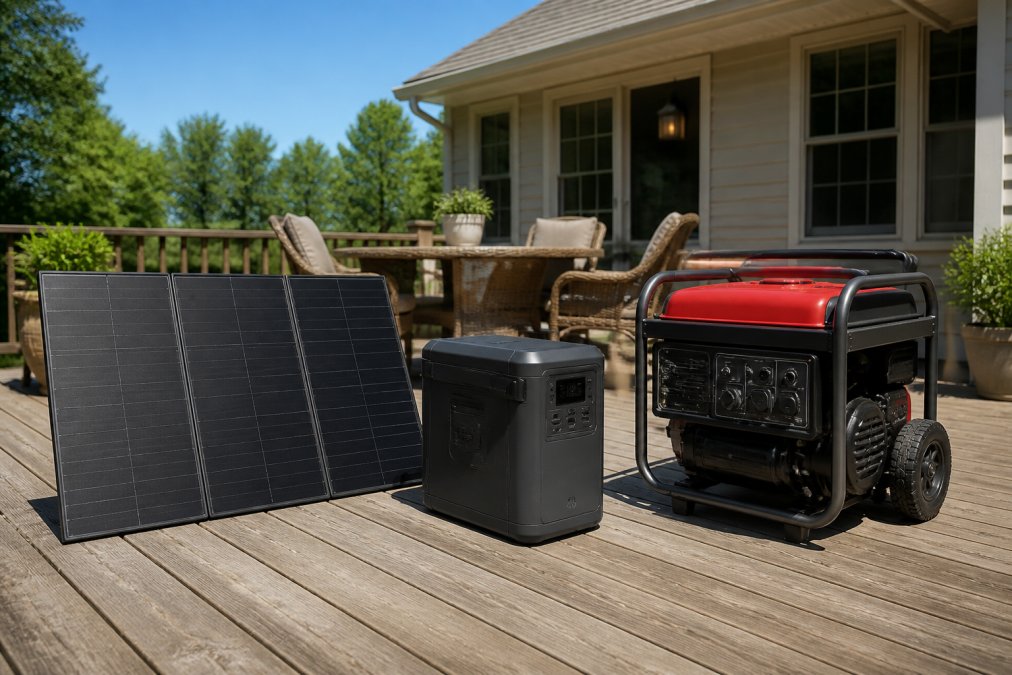
Gas generators produce more raw wattage per dollar upfront, but operational costs reverse this quickly. Gas generators require stored fuel (which degrades and creates safety hazards), produce carbon monoxide (requiring outdoor operation), make significant noise, and need regular maintenance. Solar generators produce no emissions, operate silently, require no fuel storage, and have minimal moving parts.
According to the U.S. Department of Energy's Office of Energy Efficiency and Renewable Energy, solar battery systems paired with photovoltaic panels are increasingly cost-competitive with conventional backup power over 10 years when total ownership costs are factored in.
Battery Chemistry, Inverter Output, and What the Specs Actually Mean
Understanding core specifications separates smart purchases from expensive mistakes. A solar generator comprises three components: a battery pack, an inverter, and a charge controller.
LFP vs. NMC: Which Battery Chemistry Lasts Longer
Lithium iron phosphate (LFP) and nickel manganese cobalt (NMC) are the two dominant chemistries with different performance profiles.
LFP batteries offer superior cycle life (2,000-4,000 cycles to 80% capacity) and operate safely at higher temperatures. They're heavier but ideal for stationary home backup.
NMC batteries pack more energy into smaller, lighter packages, prioritizing portability, but offer shorter cycle life (500-1,000 cycles) and greater sensitivity to heat. For home backup, LFP is the stronger choice.
Surge Power, Continuous Output, and Why Both Numbers Matter
Every inverter has two wattage ratings: continuous output (sustained indefinitely) and surge power (1-5 seconds for motor startup). A refrigerator compressor may draw 1,200W at startup despite only pulling 150W while running. If your inverter's surge capacity doesn't exceed startup loads, the unit will shut down or trip protection circuits.
The Jackery 2000 Plus and Lion Energy Safari ME both carry 6,000W surge ratings, starting virtually any household appliance. The Goal Zero Yeti 6000X's 3,500W surge is more conservative, worth noting if you're planning to start large motors.
Solar Panel Compatibility, MPPT Controllers, and Charging Methods
A solar generator is only as useful as its recharging ability. Most units support three charging methods: AC wall charging, DC car charging, and solar panel input. For home backup, solar input is critical.
The MPPT controller (Maximum Power Point Tracking) determines how efficiently the unit converts solar panel output into stored energy, typically outperforming older PWM controllers by 15-30% in real-world conditions. Before purchasing panels separately, verify their open-circuit voltage (Voc) falls within the generator's MPPT input range.
A 2,042Wh unit with 400W solar input takes approximately 5-6 hours in full sun to charge from empty. According to the National Renewable Energy Laboratory's solar resource data, most of the continental United States receives 4-6 peak sun hours daily in summer, dropping to 2-4 hours in winter. For reliable daily recharging, size your panel array to deliver 120-150% of battery capacity in peak sun hours.
Solar Generator Tax Credits 2026: What Homeowners Can Claim
The federal Residential Clean Energy Credit covers 30% of qualifying solar energy equipment costs installed in a primary residence. As documented by the IRS guidance on the Residential Clean Energy Credit, battery storage systems are eligible when charged exclusively by solar panels, either as part of a combined system or as standalone storage paired with a solar array.
A standalone portable power station charged via AC wall outlet does not qualify. For homeowners purchasing a $3,000-$5,000 solar generator system with a qualifying solar panel array, the 30% credit represents $900-$1,500 in direct tax reduction.
Long-Term Maintenance, Degradation, and Integration with Home Panels
Long-term ownership of a solar generator is simpler than gas alternatives, though not maintenance-free.
Battery degradation is the primary consideration. LFP batteries typically retain 80% capacity after 2,000-4,000 cycles. For units cycled weekly during outages, that's 40-80 years before hitting the 80% threshold. Storing batteries at partial charge (40-60%) during non-use slows degradation.
Thermal management matters for performance and longevity. Quality units include a battery management system (BMS) monitoring cell temperature and adjusting charging rates accordingly. Avoid storing units in uninsulated garages in extreme heat or cold.
Integration with home electrical panels is the most significant installation decision. Whole-home integration requires either a transfer switch or smart home panel kit (like EcoFlow's). A transfer switch prevents backfeeding power onto the grid, protecting utility workers during outage restoration. For essential-circuit-only backup, many homeowners use heavy-duty extension cords connecting critical appliances directly to the generator's AC output, avoiding installation costs and permit requirements.
LFP batteries do not contain cobalt, the most ethically problematic element in conventional lithium battery chemistry. At end of life, lithium batteries should be recycled through certified programs. The EPA guidelines on battery recycling and disposal provide resources for finding certified recyclers.
Outdoor Power & Grill stocks solar generator systems from brands including Jackery and Mango Power, with US-based fulfillment and financing available through Shop Pay for homeowners spreading costs over time.
Frequently Asked Questions
What size solar generator do I need to run a house during a power outage?
The right size depends on which appliances you need to keep running. A refrigerator, lights, phone chargers, and a router together draw roughly 500-800W continuously. For essential circuits only, a 2,000-3,000Wh solar generator covers most households for 6-12 hours. If you want to run an HVAC unit, sump pump, or medical equipment, you'll need 6,000Wh or more. Check each appliance's wattage label and add a 20% buffer for surge loads before choosing your solar generator home backup system.
Are solar generators better than gas generators for home backup?
Solar generators produce no exhaust, run silently, and require no fuel storage, which makes them safer indoors and far lower maintenance than gas models. Gas generators typically deliver higher continuous output at a lower upfront cost, but fuel availability during extended outages is a real constraint. For most suburban homeowners running essential appliances for 1-3 days, a solar generator with adequate watt-hours and solar input covers the gap cleanly. Gas still wins for multi-week outages or powering entire HVAC systems continuously.
Can I claim a federal tax credit on a solar generator in 2026?
The Residential Clean Energy Credit under the Inflation Reduction Act covers 30% of the cost of solar panels and certain battery storage systems installed on your primary residence. Standalone portable power stations typically do not qualify unless paired with a qualifying solar photovoltaic array. If you purchase a solar generator system that integrates with a permanent solar installation, the battery storage component may qualify. Consult a tax professional to confirm eligibility based on your specific system and installation method.
How long do solar generators last during a power outage?
Runtime depends on battery capacity in watt-hours and the combined wattage of connected appliances. A 2,000Wh unit powering a 200W load runs roughly 8-10 hours before recharging is needed. Lithium iron phosphate batteries, used in models like the Jackery 2000 Plus, are rated for 4,000 charge cycles, meaning the battery retains usable capacity for well over a decade of regular use. Solar input during the day extends runtime indefinitely in good conditions, making solar generator home backup practical for multi-day outages.
Can a solar generator power my whole house?
Powering every circuit in an average home simultaneously requires 10,000W or more of continuous output, which exceeds most portable solar generators. However, expandable systems like the EcoFlow DELTA Pro 3, with output up to 21.6kW and capacity expandable to 90kWh, can cover whole-home backup when paired with a smart home panel and a photovoltaic array. For most homeowners, the practical approach is to identify essential circuits, such as refrigeration, lighting, and medical devices, and size the solar generator to those loads.
Selecting the right solar generator for home backup comes down to matching capacity to your actual load requirements, choosing battery chemistry built for longevity, and understanding the tax credit landscape before you buy. Outdoor Power & Grill carries premium solar generator systems from authorized brands, with dedicated customer support to help you configure the right setup for your home. Shop the full solar generator lineup at Outdoor Power & Grill and get equipped before the next outage.
This article was written using GrandRanker